
Last Mile Delivery Insurance: How It Can Save Your Business
Last mile delivery insurance helps shippers protect freight from loss, theft, and damage during final-stage transportation. Logistics companies, e-commerce retailers, and consumers use last mile delivery insurance to protect themselves from loss or damage.
What Is Last Mile Delivery Insurance?
Last mile delivery insurance is a specific type of coverage designed to protect goods when they’re transported from the distribution center to the final destination. It helps cover financial losses tied to theft, damage, or other delivery-stage risks.
According to 49 CFR 387, carriers are required to carry specific minimum levels of insurance to cover truck accidents. Shippers can verify a carrier’s last mile delivery insurance through the Federal Motor Carrier Safety Administration’s (FMCSA) Licensing and Insurance Carrier Search.
Shippers can also obtain this insurance through their carrier or specialized broker. Even during last mile delivery, there’s still the chance that freight can be damaged and lost.
Therefore, businesses decide to get protection for their goods before they’re transported to their storefront or to a customer.
Why Is Insurance Needed for Last Mile Delivery?
Insurance is needed for last mile delivery because freight remains vulnerable to traffic accidents, mishandling, theft, weather exposure, and misdelivery during the final stage of transport. Coverage helps shippers reduce financial loss and protect customer satisfaction when problems occur.
Traffic Accidents and Road Blocks
Trucks traveling through dense urban areas risk traffic accidents that impact the quality of freight.
According to the FMCSA Motor Carrier Safety Planner, carriers are required to keep accident recordkeeping of all crashes. This information helps shippers understand a carrier’s safety rating to choose a transportation provider with adequate last mile delivery insurance,
CDL-certified drivers, and proper route planning to mitigate risks like busy urban or suburban areas or construction road blocks that lead to accidents.
Poor Freight Handling
Poor handling, even something as simple as dropping a package during loading or unloading, can hurt the item(s) inside. Mishandling cargo could also cause freight to be loaded on the wrong vehicles and sent to an incorrect destination. This can result in over, short, and damaged (OS&D) freight for a business or their customer.
Severe Weather
Rain and snow could potentially soak packages if they’re not protected. Trailers like straight trucks keep packages safe, and most drivers will try to place items somewhere dry on a customer’s property upon delivery. However, there’s still a chance weather could ruin a package and the goods inside during load and unload or as a result of truck accidents.
Freight is most vulnerable during the last mile. Use FMCSA’s Safety and Fitness Electronic Records (SAFER) System to check your carrier’s safety rating and insurance coverage.
How Much Does Final Mile Delivery Insurance Cost?
Final mile delivery insurance costs vary based on shipment value, commodity type, route distance, vehicle type, coverage limits, and exclusions. Providers calculate premiums according to shipment risk, so higher-value or higher-risk freight usually carries a higher insurance cost.
The table below shows how final mile delivery insurance costs are calculated using sample rates.
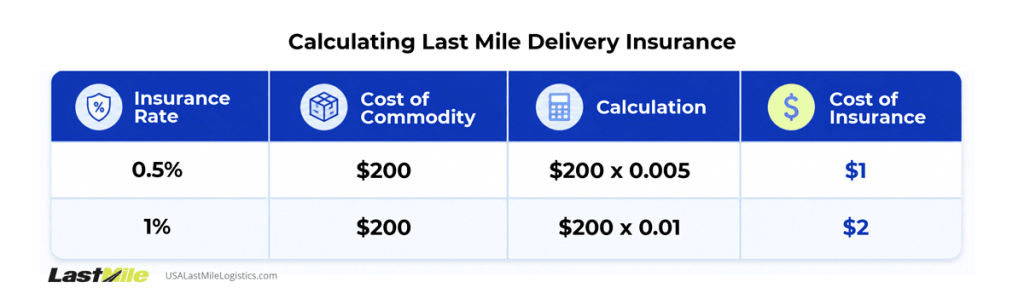
The cost of insurance also includes coverage minimums, administrative fees, and specialized rates for high-risk commodities.
Freight professionals like carriers or third-party logistics companies (3PLs) may offer more competitive rates than an insurance agency. Ask your provider about their insurance policy and request a certificate of insurance (COI) to verify if they meet the FMCSA minimum requirements.
What Influences Last Mile Insurance Rates?
Total transit mileage, cargo type, and freight claim history influences final mile delivery rates. Providers determine how much they’ll charge by calculating premiums based on the perceived risk associated with a specific delivery operation.
1. Mileage Driven
The final mile of freight transportation is only the last leg of the trip. Insurance rates include the full transit distance from origin to destination with costs rising the farther away a shipment of freight is transported.
The distance covered during the last mile of transportation varies widely. Some deliveries are completed within a few miles of a warehouse, while others require traveling cross-country through metropolitan areas. The longer trip increases fuel rates, driver time, and exposure to traffic incidents that raise final mile delivery insurance rates.
2. Cargo Type
Carriers or 3PLs consider a shipper’s commodity type and risks to handle and ship when calculating insurance premiums.
Providers sort cargo into three categories:
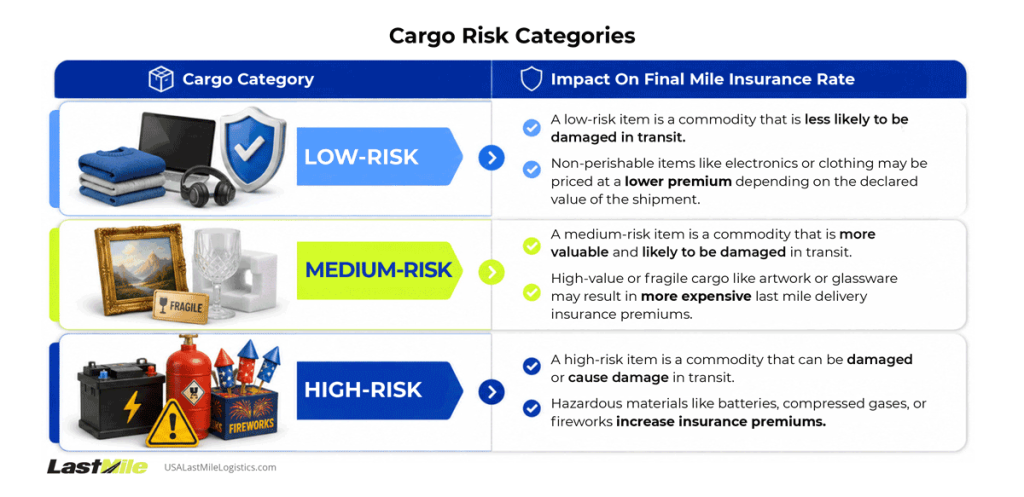
Hazardous materials (hazmat) require hazard warning labels and placards, as well as comply with the Pipeline and Hazardous Materials Safety Administration’s (PHMSA) Hazardous Materials Regulations to ship.
This process raises final mile insurance premiums as both carriers and shippers need to be hazmat certified to move this type of high-risk freight.
3. Freight Claims History
Companies that have filed a large number of freight insurance claims will often pay higher premiums.
Insurers, carriers, or 3PLs review a shipper’s claim history to assess risk. Frequent claims signal a higher chance of freight loss and result in a higher insurance premium.
Shippers who have low to no claim history are assessed as low-risk and could qualify for preferred rates.
Need coverage for a final-mile shipment? Request a quote with your commodity type, shipment value, and delivery route to review your insurance options and confirm your carrier meets FMCSA requirements. Call (866) 569-1445 to speak with our team or fill out your quote today.
Sources:
49 CFR Part 387 – Minimum Levels of Financial Responsibility for Motor Carriers
Licensing and Insurance Carrier Search, FMCSA
Motor Carrier Safety Planner, FMCSA
Commercial Driver’s License Program, FMCSA, 2025
SAFER Web, FMCSA
Hazardous Materials Regulations, PHMSA, 2017
1 comment
Jeremy Gilligan
Need a quote